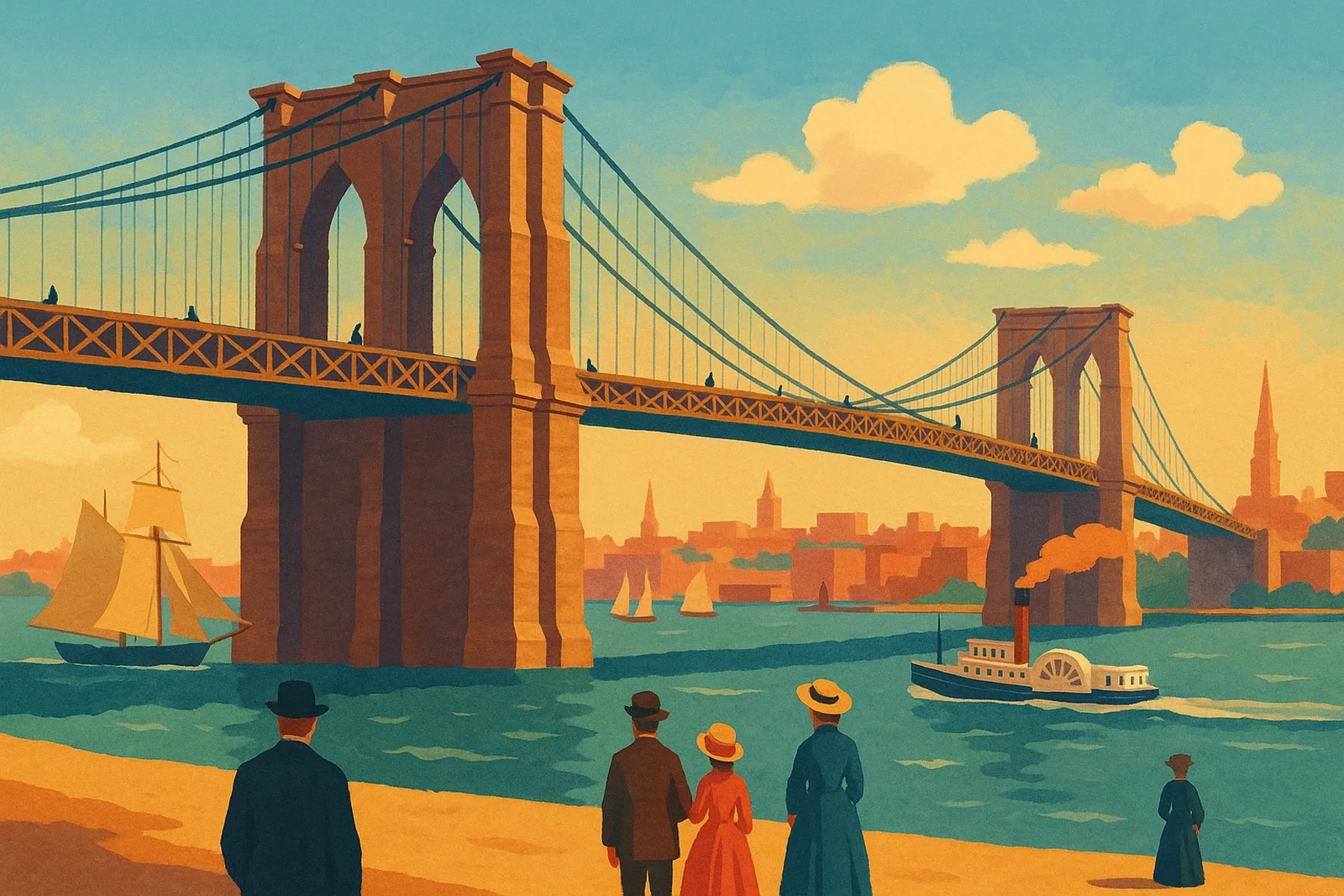
The Brooklyn Bridge was bought with a bribe, built by men who were dying as they worked, and strung with wire its own contractor had already been caught faking. It opened anyway, and it is still standing.
Most accounts of the bridge are about the Roeblings, and they should be. But the family tragedy is only one of the things that happened here, and it is not the strangest. What follows is the documented record: what it cost to get the bridge approved, what it cost to build, and what it took to convince New Yorkers to walk on it.
It was bought before it was built
The New York Bridge Company was chartered in 1867. William M. Tweed, then at the centre of Tammany Hall and of the city's money, took a reported $60,000 to move the charter through, carried to him in a carpet bag. Tammany men held a controlling block of the private stock. The bridge that would become the city's most photographed object began as a piece of machine politics, and the men who approved it stood to profit from it.
The engineer who never saw the ground broken
John A. Roebling designed it and did not live to build it. In July 1869, surveying the Brooklyn tower site at Fulton Ferry, his foot was crushed against a piling by an arriving boat. He refused conventional treatment, contracted tetanus, and died weeks later. His son Washington took over.
Washington was then disabled by the work itself. The towers were sunk using caissons, airtight chambers pressurized to keep the river out, and the men inside came up too fast. They called it caisson disease; we call it the bends. It crippled Washington Roebling to the point that he directed construction for years from a window overlooking the site, watching through a telescope.
Emily Warren Roebling
His wife, Emily Warren Roebling, learned the engineering. She carried his instructions to the site, dealt with the contractors and the trustees, answered technical questions in her own right, and for more than a decade was in practice the person running the project. When the bridge opened she was the first to cross it, and she is commonly said to have carried a rooster with her as a symbol of victory.
The fraud that is still in the cables
J. Lloyd Haigh held the contract for the steel wire. He was found to be swapping rejected wire for approved wire after inspection, so that material already condemned went into the cables. By the time the fraud was caught, the bad wire was spun in and could not be pulled out. Washington Roebling's answer was to add roughly 150 extra wires to each cable to carry the margin the fraud had eaten.
A note on this one. The figure of 150 additional wires per cable rests principally on David McCullough's The Great Bridge (pp. 443–444). The fraud itself is well attested; that specific number is not as widely corroborated as the rest of this page, and we flag it rather than let it pass as settled.
It opened on 24 May 1883. Six days later, twelve people died.
The opening was a civic spectacle, with President Chester A. Arthur in attendance. Six days later, on 30 May 1883, Memorial Day, the promenade was packed with holiday crowds. On the narrow wooden stairs at the Manhattan approach, a woman fell. Another screamed that the bridge was collapsing. The crowd behind, unable to see what was happening and unable to stop, pressed forward into the stairway.
Twelve people were crushed to death and thirty-six were seriously injured. Nothing had been wrong with the bridge. What killed them was the fear that something might be.
Twenty-one elephants
The panic left a practical problem: New Yorkers were not certain the bridge would hold. P. T. Barnum offered the solution, and it served him as well as it served the city. On 17 May 1884, he walked a column of twenty-one elephants across it, led by Jumbo, the most famous animal in the world.
It was an advertisement and it was also a proof. If the span could carry Jumbo, it could carry anyone. The crowds came back.
Common questions
- How many people died in the Brooklyn Bridge stampede?
- Twelve people were killed and thirty-six seriously injured on 30 May 1883, six days after the bridge opened. The cause was a panic on the stairway at the Manhattan approach. The structure itself was sound.
- Why did P. T. Barnum walk elephants across the Brooklyn Bridge?
- To demonstrate publicly that the bridge was safe after the stampede had shaken confidence in it. On 17 May 1884 he led twenty-one elephants across, headed by Jumbo. It doubled as publicity for his circus.
- Did John Roebling see the Brooklyn Bridge finished?
- No. He died of tetanus in July 1869, before construction was properly under way, after his foot was crushed at the Brooklyn ferry slip while surveying the tower site. His son Washington succeeded him and was himself disabled by caisson disease.
- Was Emily Warren Roebling the chief engineer of the Brooklyn Bridge?
- Not in title. Washington Roebling remained chief engineer, but after his illness Emily Warren Roebling learned the engineering, carried his direction to the site, dealt with contractors and trustees, and in practice ran the project for more than a decade.
- Is there faulty wire in the Brooklyn Bridge cables?
- Yes. The contractor J. Lloyd Haigh substituted rejected wire for approved wire after inspection, and by the time it was discovered the condemned wire was already spun into the cables. Extra wire was added to compensate, and the bridge carries that margin to this day.
Sources
- David McCullough, The Great Bridge (1972), esp. pp. 443–444 on the Haigh wire fraud.
- Brooklyn Bridge stampede, for the 30 May 1883 casualty figures.
- The New York Historical, on Barnum's 1884 elephant crossing.
- Library of Congress, Chronicling America, contemporary newspaper coverage of the opening and the panic.
- History.com, on the construction deaths and caisson disease.
Compiled from the sources above and checked against them. Last reviewed 2026-10-08.